
Conservation · Watamu, Kenya
Kenya's Battle to Protect Sea Turtles, at Sea and on Land

By Amos Kiarie, Journalist · Sep 12, 2025 · 6 min read
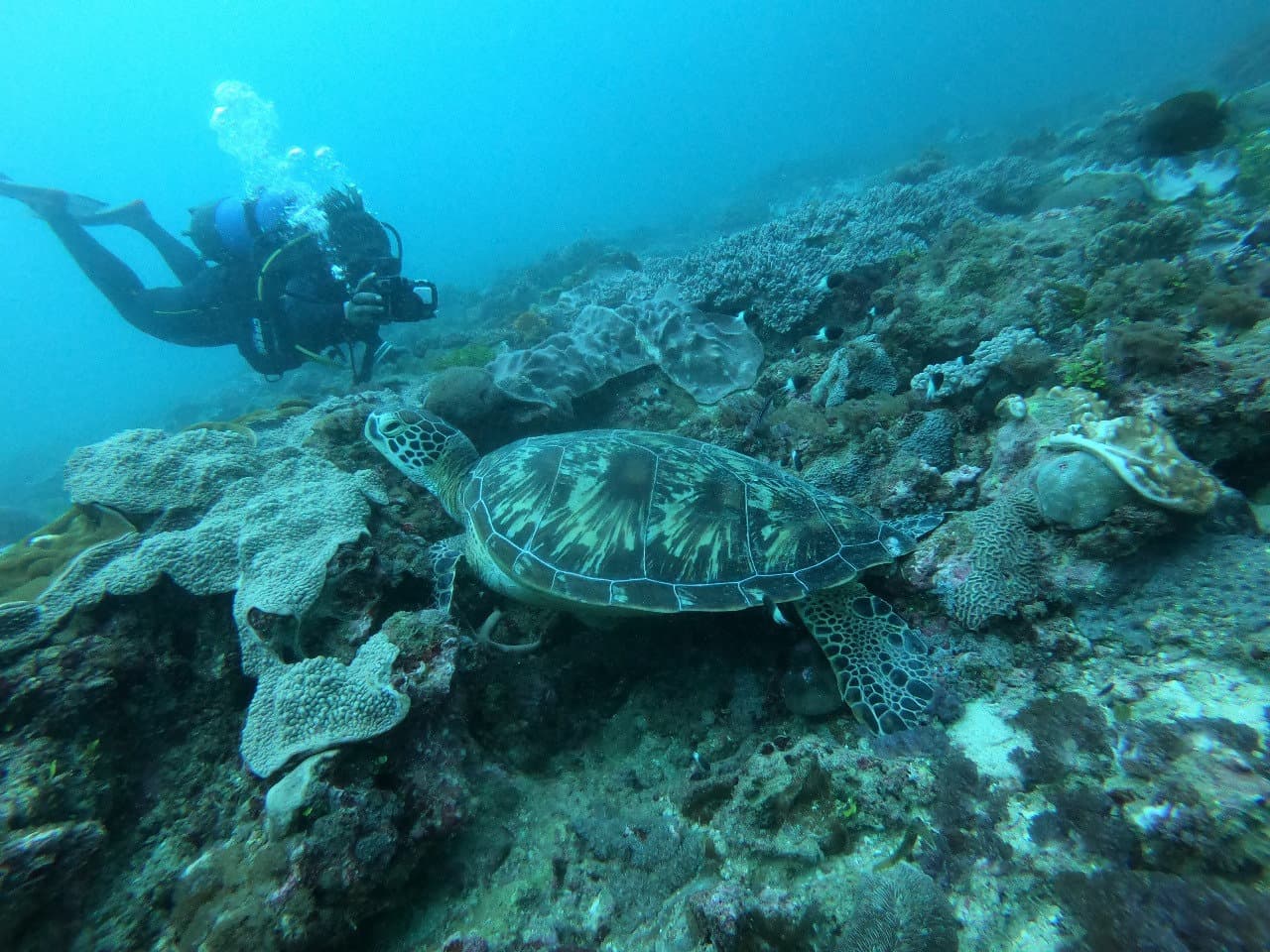
Kenya’s sea turtles, five of the world’s seven species, are facing mounting threats from poaching, plastic pollution, and entanglement in fishing gear. Along the coast, I have witnessed community-led groups and conservation NGOs racing to save them, guarding nests, releasing hatchlings, and even using photo identification to track populations offshore.
In the cool evening hours, when the sun’s heat had faded, I stood on the sandy shoreline at Mtwapa, watching a team release turtle hatchlings into the ocean. Sixty days earlier, a female green turtle had come ashore to lay her eggs. Now, with careful preparation, the conservation team washed their hands and set up a guiding path to lead the tiny turtles from the temporary nest (a protective enclosure shielding the eggs from being stepped on or stolen) toward the sea. As the tide recedes, Mike Mwaura Ali bends down to scoop up a struggling hatchling from the wet sand, ensuring it joins the others on their dangerous journey. For Ali, moments like this are more than small victories; they are the culmination of a decades-long calling to protect a species teetering on the edge of extinction.
![Members of Mtwapa Maweni Turtle Project release dozens of green turtle hatchlings into the Indian Ocean at Mtwapa Beach, guiding them safely past shorebirds and crabs in a bid to boost survival rates. This year alone, the community-led group, founded in 2008 and officially authorized in 2020, has released over 8,000 hatchlings [Amos Kiarie]](/_next/image?url=%2Fimages%2Fstories%2Fkenya-s-battle-to-protect-sea-turtles-at-sea-and-on-land%2F02-inline.jpg&w=1920&q=75)
His journey began in 1995, fresh out of school, when he joined his grandfather as a fisherman. One afternoon, they caught a turtle. His grandfather suggested eating it, citing long-held beliefs that turtle meat cured ailments and boosted male virility. But Ali resisted. “I couldn’t bring myself to kill it. It was struggling in my hands, and all I could think was: what if this was the last one? My grandfather laughed and told me I was soft, but I knew I had to do something," he recalled. That moment planted the seed of a mission. He began speaking to fellow fishermen about the importance of turtles, often facing ridicule. The tide of tradition was strong, but he refused to let it sweep him away. According to KWS, the consumption of turtle products remains deeply ingrained in coastal culture: eggs fetch up to Sh1,000 (USD$8) per clutch, oil trades for Sh1,300 (USD$10) per liter, and carapaces sell for between Sh1,000 (USD$8) and Sh2,600 (USD$20).
![Volunteers from the Mtwapa Maweni Turtle Project locate and secure a vulnerable nest site under palm shade at Mtwapa Beach to reduce trampling and poaching risk. [Amos Kiarie]](/_next/image?url=%2Fimages%2Fstories%2Fkenya-s-battle-to-protect-sea-turtles-at-sea-and-on-land%2F03-inline.jpg&w=1920&q=75)
In 2008, a small group of like-minded locals formed the Mtwapa Maweni Turtle Project. At first, it was a grassroots effort without funding or recognition, but in 2020, they received official authorization to carry out turtle conservation along the Kenyan coast. Today, the group has 50 active members, mostly youth, split almost evenly between young men and women. He explained to me, “Our mission is simple yet monumental: to safeguard turtle nests, protect hatchlings, and nurture community understanding of why these ancient mariners matter. In 2024 alone, we oversaw 22 nests and released more than 8,000 hatchlings into the ocean. The work is painstaking, and the odds are brutal: out of every 1,000 hatchlings, only one survives to adulthood.” Operating on minimal resources, the team reinvests small earnings from sponsorships, community events, and eco-friendly crafts into their work, buying protective gear, building nest enclosures, and funding beach clean-ups. These efforts not only protect turtles but also provide livelihoods for many in the region.
![Mtwapa Maweni Turtle Project members reinforce a nesting area and clear a safe corridor so hatchlings can reach the surf without obstacles. [Amos Kiarie]](/_next/image?url=%2Fimages%2Fstories%2Fkenya-s-battle-to-protect-sea-turtles-at-sea-and-on-land%2F04-inline.jpg&w=1920&q=75)
Kenya’s coastline is home to green, hawksbill, olive ridley, loggerhead, and the rarely sighted leatherback turtles, all endangered and legally protected. Yet threats persist: poaching, entanglement in fishing gear, plastic ingestion, coastal development, and rising seas. I observed firsthand how dangerous plastic can be: globally, more than half of dead turtles have ingested it; in Kenya, plastic makes up about 65 percent of beach litter. Fishing gear is equally deadly: over 250,000 turtles die annually worldwide from entanglement, and along Kenya’s coast, more than 80 percent of deaths are linked to it. Each species plays a vital ecological role: green turtles trim seagrass beds, hawksbills feed on sponges that threaten coral, and leatherbacks consume vast numbers of jellyfish. But survival starts on land, where females dig nests in the sand and lay between 85 and 200 eggs. After 50 to 70 days of incubation, hatchlings emerge at night, guided by the moon’s reflection on the sea. For the Mtwapa team, protecting nests is a race against time. Ali told me, “We patrol beaches during nesting season, relocate vulnerable nests, and shield them from human disturbance and predators. Once hatchlings emerge, we clear paths to the sea and ensure they are not disoriented by artificial lights.”
![Diana Kerubo Nyakundi, a marine biologist with ORP Kenya, in her diving gear before heading out to document sea turtles along Kenya’s coast. [Courtesy: ORP Kenya]](/_next/image?url=%2Fimages%2Fstories%2Fkenya-s-battle-to-protect-sea-turtles-at-sea-and-on-land%2F05-inline.jpg&w=1920&q=75)
The fight extends beyond Mtwapa. In Diani, a turtle ambassador trained by the Olive Ridley Project-Kenya (ORP Kenya) sensitizes her community through storytelling and village gatherings. She shared, “The ocean is our lifeline. When I graduated from the ORP-Kenya at 28, I made it my mission to sensitize the community. Today, people call me whenever they see a turtle entangled or stranded, and many who once ate them now protect them. That transformation gives me hope.” Across the coast, BMU groups are pioneering eco-tourism, organizing hatchling release tours and beach clean-ups that generate income while educating communities. According to IFAW Marine Conservation Programme Officer Lilian Mulupi, conservation in Kenya has largely focused on nesting females and hatchlings. While there are reliable records of how many females nest and how many hatchlings are released, she explained that a significant data gap remains on turtle populations at sea. “Reliable data exist on how many females nest and hatchlings are released, but offshore populations remain a mystery. One of the biggest challenges we face in turtle conservation is the lack of reliable data and information about these species,” she said. She added, “Without proper records on their populations, behaviors, and migration routes, it becomes very difficult to design effective protection measures. Many communities along the coast also don’t fully understand the ecological importance of turtles, which makes awareness and education just as critical as field research.” To bridge this gap, ORP-Kenya is pioneering photo identification to track turtles at sea. Diver and turtle biologist Diana Kerubo Nyakundi spends mornings photographing turtles underwater, each unique facial pattern acting like a fingerprint. She told me, “When I dive, I carefully record details such as the turtle’s species, its behavior (whether swimming, resting, foraging, or at a cleaning station) and its size and shell patterns. We approach from at least two meters away to avoid disturbing them, but turtles are shy, so patience is key. Each photo is scored for clarity, focus, and lighting, then merged into our catalogue. Just like human fingerprints, turtles have unique facial patterns, and once confirmed, these images are uploaded into the global Internet of Sea Turtles database.” Since 2018, her work has helped catalogue more than 700 green turtles, fewer than 100 hawksbills, and over 1,000 individual sightings. Each turtle is assigned an ID and logged into the global monitoring network. Leah Mainye, ORP Kenya’s chairperson, explained to me that the group began in 2018 with diver monitoring and was formally registered as an NGO in 2024. She said, “The long-term data helps map spatial and temporal trends, enabling identification of high-priority conservation areas and monitoring population structure and habitat use along Kenya’s south coast. ORP Kenya now plans to expand across the Diani area by mapping turtle sites and strengthening protection. When communities learn the role turtles play in ocean health, they become powerful allies in conservation.”
![An ORP Kenya diver uses a camera to capture a turtle’s unique facial scute pattern from a respectful distance for photo identification and the Internet of Sea Turtles database. [Courtesy: ORP Kenya]](/_next/image?url=%2Fimages%2Fstories%2Fkenya-s-battle-to-protect-sea-turtles-at-sea-and-on-land%2F06-inline.jpg&w=1920&q=75)
Written by
Journalist
Amos KiarieAmos Kiarie is a journalist and storyteller who turns complex ideas into clear, engaging narratives. He writes across formats, from features and blog posts to scripts and social content, grounding each piece in careful research and crisp prose. Curious and adaptable, he tracks emerging trends to deliver stories that inform, inspire, and connect with readers.
Read full profile →Related stories
- Conservation
 Maasai Mara, Kenya
Learning to See Connection: What Long-Term Photography Reveals About Conservation
Returning to the same landscapes year after year, a photographer learns that the real story is rarely the dramatic moment — it is the slow relationship between land, wildlife, and the people who tend it.

Georgina Goodwin
Apr 15, 20264 min
- Conservation
 Lamu, Kenya
Flipflopi Project: Plastic Waste to Recycled Sailboat - Kila Kitu Inawezekana
A dhow built entirely from recycled plastic sails the East African coast, carrying a simple message about the circular economy: everything is possible.

Neeva Sumaria
Mar 26, 20268 min
- Conservation
 Amboseli, Kenya
Redefining Conservation: Animals and People Thriving Together
Moving past the fence line: the projects proving that wildlife and the communities beside it can recover side by side.

Azzedine T. Downes
Dec 31, 20246 min
- People
 Serengeti National Park, TanzaniaNew
Holding the Door Open
From Ireland to Tanzania, from Hugo van Lawick's Serengeti camp to Queens and the ASC, Sophie Darlington reflects on access, mentorship, representation, and the responsibility to bring others in.

Sophie Darlington
Jul 23, 20265 min
- Birds
 Agartala, IndiaNew
The Rarest Bird in Agartala: a Global Story of Birds Disappearing in Plain Sight
In a north-eastern Indian town where old trees fall and ponds are filled overnight, the scarcest species isn't a bird at all. It's the birdwatcher, and noticing may be the simplest conservation there is.

Dhrubajyoti Bhattacharjee
Jun 30, 20267 min
- Wildlife
 Holbox Island, Mexico
Holbox Wildlife: How Urbanization Is Reshaping Mexico's Yucatán Peninsula
On a sandbar island where flamingos still wade the shallows, rapid development is rewriting the rules of coexistence between people and the wild.

Tamara Blazquez Haik
Feb 17, 20266 min
- Wildlife
 Svalbard, Norway
Climate Change and the Arctic Fox: The Red Fox Invasion
As the Arctic warms, the red fox is pushing north into territory the arctic fox has held for millennia — a quiet contest with the climate as referee.

Jacob Buck
Aug 15, 20244 min
- Marine
 French Polynesia
Guardians of the Deep: Lessons from Humpback Whales on Conservation and Connection
What the great migrations of humpback whales can teach us about resilience, recovery, and the threads that link distant oceans.

Rachel Moore
Mar 5, 20254 min