
Birds · Little Rann of Kutch, Gujarat, India
A Bed of Roses: Flamingos in the Little Rann of Kutch
A monsoon encounter with flamingos in the Little Rann of Kutch brings a childhood dream into view, alongside the delicate balance of water and salinity that sustains their wetland home.
By Jair Luke Sam, Writer & Birder · Oct 31, 2026 · 13 min read
Some dreams arrive suddenly.
Others wait patiently for years.
Mine began in front of a television.
As a child, I was captivated by wildlife documentaries. While most people remember the roaring lions of the Serengeti or polar bears wandering across Arctic ice, I found myself mesmerized by something far quieter, flamingos.
I remember sitting cross-legged on the floor, watching countless National Geographic documentaries that transported me to places I could barely pronounce. Vast African lakes shimmered beneath the morning sun; their shorelines painted in impossible shades of pink. Thousands upon thousands of flamingos moved together like a single living organism. Every now and then the entire flock would rise into the air, filling the screen with wings streaked in crimson, black and soft rose.
They seemed almost unreal.
Elegant.
Graceful.
Almost mythical.
What fascinated me wasn't just their beauty. It was the places they lived. Lonely salt lakes. Endless wetlands. Landscapes so wild that they seemed untouched by time. Flamingos were never simply birds in those films, they were symbols of wilderness itself.
Back then, seeing one in real life felt impossible.
Years passed.
Life became busier. School gave way to exams, responsibilities multiplied, and those childhood afternoons spent watching wildlife documentaries slowly became distant memories. But somewhere in the back of my mind, that image remained, a horizon filled with pink birds taking flight over silent wetlands.
Some dreams refuse to fade.
When I learnt that the Little Rann of Kutch in Gujarat was one of India's most remarkable flamingo landscapes, I knew I had to visit. Most birders come during winter, when migratory birds transform the Rann into one of the richest birding destinations in Asia.
I went during the monsoon.
Friends thought it was an unusual choice.
"Why visit a salt desert when it's flooded?"
That question, I would soon discover, misunderstood the Little Rann entirely.
The Little Rann isn't really a desert, not in the way most people imagine. For much of the year it appears dry, harsh and almost lifeless. But with the arrival of the southwest monsoon, everything changes.
Rivers flowing from mainland Gujarat spill into the basin. Rainwater spreads across the flat landscape, turning vast stretches of cracked earth into shallow wetlands. The famous white salt flats disappear beneath a sheet of water. Islands of slightly higher ground, known locally as bets, emerge like tiny archipelagos surrounded by a shimmering inland sea.
It is a landscape in transition.
Neither land nor lake.
Neither desert nor marsh.
Standing still beneath enormous monsoon skies, it feels as though nature has not yet decided what it wants this place to become.
The monsoon had transformed everything.
The scent of wet earth hung heavily in the air. Dark clouds drifted lazily overhead, occasionally allowing shafts of golden sunlight to illuminate patches of emerald grass. Every puddle reflected the sky. The entire landscape seemed alive.
It was difficult to imagine this same place becoming a blinding white salt desert just a few months later.
The next morning began quietly.
The kind of quiet that only exists after a night of rain.
There was no rush.
No grand plan.
Just the hope that somewhere out in the flooded wilderness, the birds would reveal themselves.
As we walked past the resort's golf course, my eyes drifted almost absentmindedly toward one of the shallow water hazards.
Then I stopped.
Standing alone in the water was a bird that had lived in my imagination since childhood.
A flamingo.
For a few seconds, I couldn't move.
After years of watching documentaries, reading books, and dreaming about distant wetlands, I was finally looking at one through my own eyes.
Not on a television screen.
Not through the lens of someone else's camera.
But here.
In front of me.
Its reflection shimmered in the still water as it swept its strangely shaped bill from side to side beneath the surface. Occasionally it paused, lifted its head, and droplets rolled down its pale pink neck before falling silently back into the wetland.
It was impossibly elegant.
And completely alone.
That was the first thing that struck me.
Flamingos are among the most social birds on Earth. They gather in flocks that can number in the thousands. Solitude seemed almost unnatural for a bird whose life revolves around companionship.
What was it doing here?
Had it become separated from a larger group?
Was it simply feeding before continuing elsewhere?
Or was there a hidden flock somewhere beyond the flooded horizon?
The flamingo offered no answers.
Instead, it continued feeding in perfect silence, occasionally glancing toward the distant wetlands stretching beyond the resort.
Then, without warning, it straightened its neck.
Its wings unfolded.
Pink.
Crimson.
Jet black.
Colours I had admired for years on television suddenly burst into life before me.
The flamingo began to run across the shallow water.
One stride.
Two.
Three.
Then, with effortless grace, it lifted into the humid monsoon sky.
I looked at our guide. He smiled. "We should follow it."
The flamingo climbed steadily, its broad wings beating with surprising power before it settled into an effortless glide. Against the dark monsoon clouds, its pale pink body stood out like a brushstroke across the sky.
Within moments it was little more than a distant silhouette.
Yet somehow, we never lost sight of it.
Our jeep rolled out of Rann Riders and onto the muddy tracks leading into the Little Rann. The resort disappeared behind us, replaced by an ever-changing landscape that seemed impossible to define.
It was breathtaking.
And wonderfully alive.
Every kilometre revealed something new.
The flamingo was still ahead of us.
Sometimes we lost it against the clouds, only for it to reappear moments later, its long neck and trailing legs unmistakable.
Where was it leading us?
The tracks became progressively wetter.
The jeep lurched through puddles and patches of sticky clay, tyres occasionally slipping before finding grip again. Finally, after nearly an hour of weaving through flooded grasslands and shallow wetlands, our guide brought the vehicle to a gentle stop.
"This is as far as we go."
Ahead of us lay an immense mudflat. It looked deceptively solid. The first step proved otherwise.
My boot sank several centimetres into the grey clay with a soft squelch. Pulling it free required far more effort than expected, and by the third step, each boot seemed to have doubled in weight.
The mud had a personality of its own. It clung stubbornly to everything.
Every few metres we had to stop and scrape away thick layers of sticky clay from our boots before continuing. Walking demanded complete concentration. One careless step could leave you ankle-deep, laughing and struggling to regain your balance.
Yet no one complained.
There was something oddly enjoyable about it.
The silence.
The open sky.
The anticipation of not knowing what waited beyond the next stretch of wetland.
The only sounds were the distant calls of lapwings and the occasional splash as tiny fish disturbed the surface of nearby pools.
After nearly twenty minutes of careful walking, the landscape opened before us.
A broad, shallow lagoon stretched across the horizon.
It appeared almost empty.
Almost.
Then I noticed a faint wash of colour reflected in the water.
Not blue.
Pink.
At first, I thought it was another trick of the light.
The monsoon sky had been playing with colours all morning.
But as we walked closer, the pink began to take shape.
Long necks. Slender legs. Graceful movements.
Flamingos.
Not one. Not two. But an entire flock.
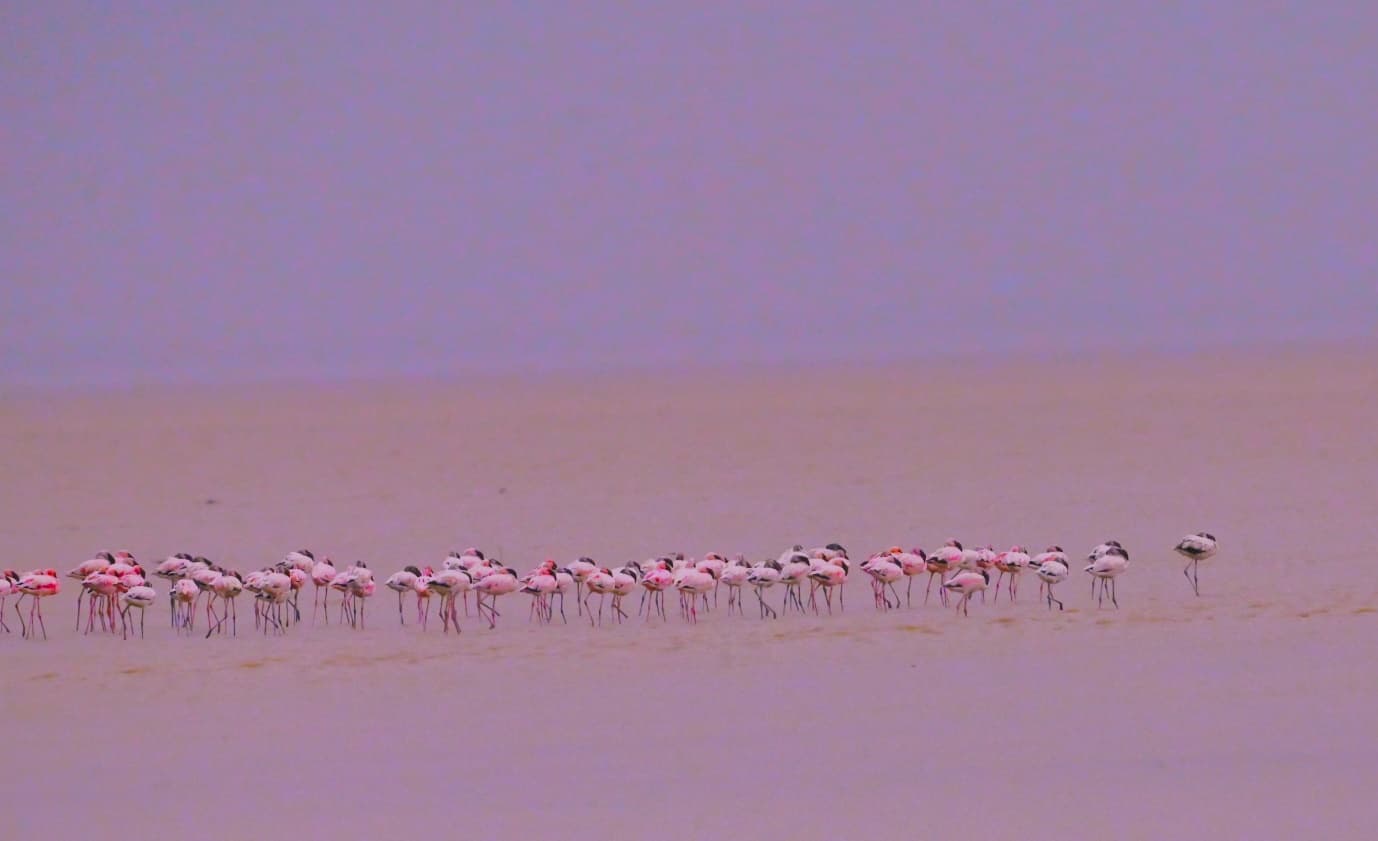
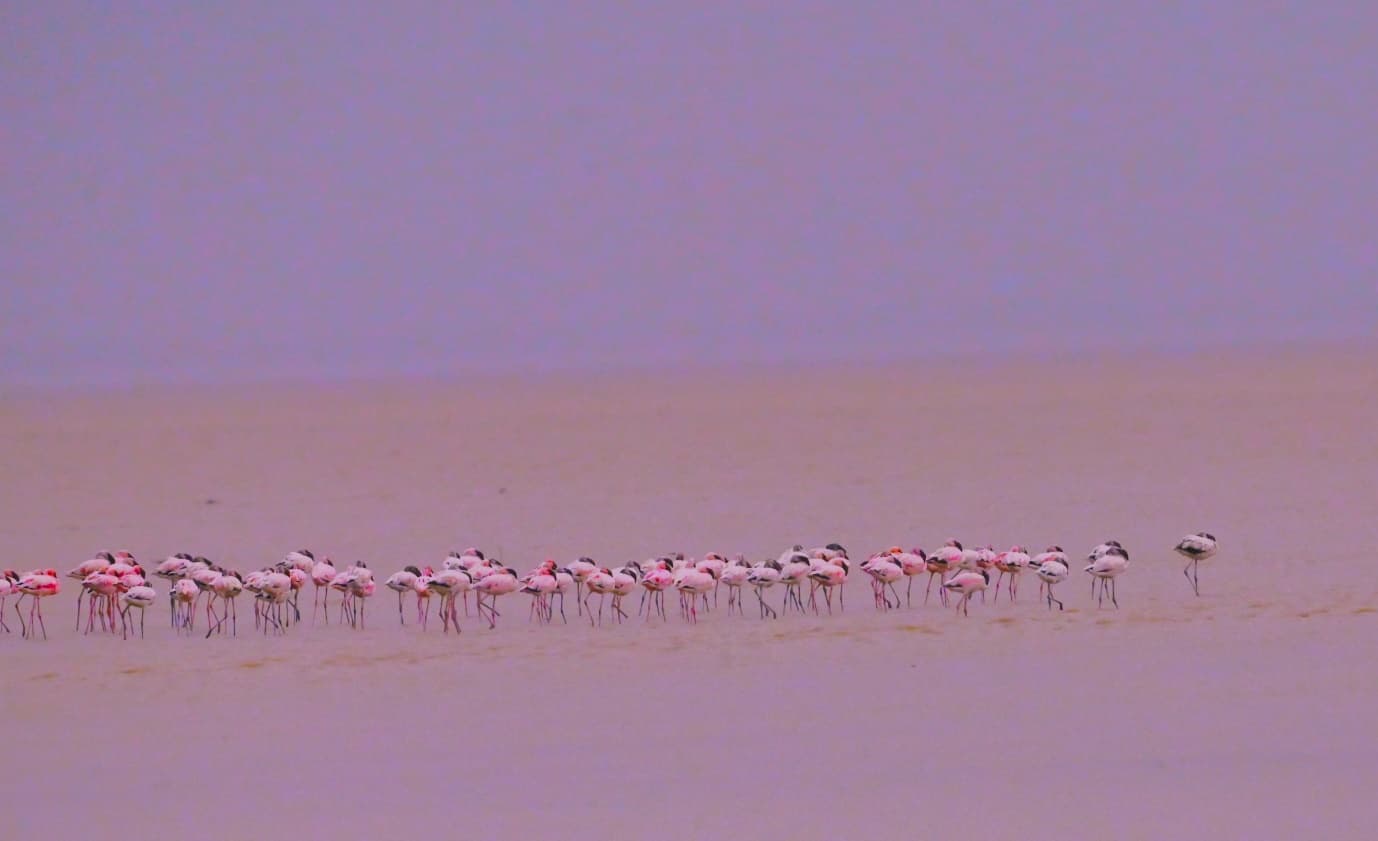
Spread across the lagoon, a couple of dozen Lesser Flamingos fed quietly in the shallow water, their reflections shimmering with every ripple. Some stood shoulder to shoulder, methodically sweeping their specialized bills from side to side beneath the surface. Others rested on one leg, occasionally preening feathers that seemed almost white until the sunlight revealed delicate shades of blush and rose.
It was impossible to know which bird we had followed from the resort. The lone flamingo had become part of something much larger. We settled quietly at the edge of the wetland, careful not to disturb them. Through my binoculars, every movement became a lesson in adaptation.
Flamingos feed upside down, an extraordinary behaviour made possible by one of the most specialized bills in the bird world. Their tongue works like a powerful pump, forcing water through fine comb-like structures called lamellae that filter out tiny algae, diatoms, insect larvae and microscopic crustaceans. It is those tiny crustaceans, rich in natural pigments called carotenoids, that give flamingos their famous pink colour.
Without them, flamingos would be almost white.
The birds fed patiently, each one tracing gentle arcs through the water as though choreographed. Occasionally two birds would raise their heads together, exchanging soft, goose-like calls before returning to feed.
There was no urgency. No competition. Only quiet rhythm.
Now I was standing only a few dozen metres away, watching them through my own eyes.
The dream had become real. And the morning was far from over. Time seemed to lose all meaning. How long we stood there, I honestly couldn't tell. Perhaps it was thirty minutes. Perhaps it was an hour.
Out in the Little Rann, time isn't measured by clocks. It is measured by the movement of clouds, the changing light on the water, and the lives of the birds around you.
The flamingos carried on as though we didn't exist.
One by one, they drifted through the shallow lagoon, sweeping their heads gracefully from side to side beneath the water. Every few seconds they would lift their bills, allowing tiny droplets to fall back into the wetland before taking another slow step forward.
Their impossibly long legs moved with remarkable precision through the soft mud, disturbing little more than a few ripples. The surface of the lagoon mirrored every movement, creating the illusion that another flock was feeding beneath them.
From time to time, one bird would pause, stretch its neck high above the others and quietly survey its surroundings before returning to feed. Others busied themselves with grooming.
A flamingo's feathers are its passport to survival. Every feather must remain perfectly aligned and waterproof. Using their bills, the birds carefully worked through each feather, spreading oils that keep their plumage in perfect condition. Occasionally one bird would stretch both wings to their full extent, revealing brilliant flashes of scarlet hidden beneath otherwise pale feathers.
I found myself smiling.
For years, I had watched these birds on television, wondering what it would feel like to stand beside them. The documentaries had shown the spectacle. They had shown the migrations. The breeding colonies. The aerial shots of endless pink lakes. But they had never captured the feeling. They couldn't show the scent of rain-soaked earth carried by the monsoon breeze. They couldn't recreate the sticky mud clinging stubbornly to your boots. They couldn't let you hear the quiet conversations between flamingos drifting gently across the wetland. Some experiences simply refuse to fit inside a screen.
As the morning wore on, the light began to change. The clouds that had shielded us for much of the day slowly parted, allowing sunlight to spill across the lagoon. Almost instantly, the birds seemed brighter. The water became a mirror of silver. Every reflection sharpened. Every feather glowed. The entire wetland felt alive.
Then something changed.
It was almost too subtle to notice at first. One flamingo stopped feeding. Then another. Heads began to rise across the lagoon. The soft murmur of feeding birds gave way to gentle calls echoing over the water.
Our guide whispered quietly. "They're getting ready."
Ready for what?
Within moments, several birds began walking with greater purpose.
One stretched its wings. Another shook water from its feathers.
The flock seemed connected by an invisible thread, each bird responding to movements almost before they happened.
Then, without warning, one flamingo leaned forward and began to run.
Its long legs slapped against the water's surface, sending tiny sprays of droplets into the air. A second bird followed. Then a third. Within seconds, the entire lagoon erupted into motion.
Dozens of flamingos raced across the shallow water together. Powerful wings beat furiously. Water exploded beneath them.
The silence that had defined the morning disappeared beneath the deep rhythm of beating wings.
One after another, the birds lifted effortlessly into the humid monsoon air.
For a brief moment they flew directly towards us.
My heart raced.
The sound was unforgettable. Not loud. Not chaotic. Just the steady, powerful rhythm of wings cutting through damp air.
The flock climbed together, forming a loose ribbon of pink against towering grey clouds.
Their reflections shimmered below them until birds and sky became almost impossible to separate.
I lowered my camera. Some photographs are never taken. Not because you miss the opportunity...
…But because the moment deserves your complete attention.
This was one of those moments.
I simply watched.
The flock circled gracefully above the wetland once, almost as if taking one final look at the lagoon that had sustained them.
Then they turned north, gradually shrinking against the enormous sky until each bird became nothing more than a tiny speck.
And finally...
Nothing.
Only clouds. Only silence. Only ripples spreading slowly across the water where they had stood only moments before.
We remained there for several minutes.
No one spoke.
There was nothing left to say.
As we began the slow walk back across the mudflat, I looked over my shoulder one last time.
The lagoon appeared empty again.
If someone had arrived a few minutes later, they would never have known that dozens of flamingos had transformed it into one of the most beautiful scenes I had ever witnessed.
It reminded me how fleeting wildlife encounters really are.
Nature doesn't perform on schedule.
It doesn't wait for visitors, it simply allows us, every now and then, to witness something extraordinary.
Walking back through the sticky monsoon mud, I couldn't stop thinking about how delicately balanced this place is.
The Little Rann exists because of water, but only in the right amount.
Each year, the southwest monsoon breathes life into these wetlands. Rain and rivers flood the basin, creating a temporary world of shallow lagoons and marshes that support countless insects, crustaceans, fish, amphibians and birds. As the months pass, the water slowly evaporates, leaving behind the saline conditions that make this ecosystem so unique.
That balance is becoming increasingly unpredictable.
During our visit, many people spoke about how much rain Gujarat had received. Roads had flooded. Wetlands were fuller than usual. While no single monsoon can be blamed entirely on climate change, scientists have found that a warmer atmosphere can fuel heavier rainfall events, and across many parts of India these extremes are becoming more common.
For flamingos, those changes matter, too little water, and their feeding grounds dry up before enough food develops. The very food that the depend upon is now at risk because of algal crises and beta-carotine loss.
Too much freshwater, and the salinity changes, altering the delicate communities of algae and tiny crustaceans that colour their feathers and sustain their lives.
Even small changes can ripple through an entire ecosystem.
And it isn't only these flamingos. Around the world, birds are quietly telling us the same story.
Shorebirds arrive at wetlands that have been replaced by apartment complexes, seabirds travel farther because warming oceans have shifted the fish they depend upon, mountain birds climb higher as temperatures rise, And, migratory birds encounter storms that did not exist when their ancient flyways first evolved. Even here, in the Little Rann, this place has been declared a 'wasteland' and the Narmada canal has been causing chemical biomagnification in this precious wetland.
The Little Rann should be declared a 'Ramsar Wetland' of international importance. This will help it to be removed from the category of "Wasteland" in government records, which will legally prevent the expansion of the surrounding industrial zone (GIDC).
Research shows that excess fresh water from the Narmada Canal from the Sardar Sarovar Hydro Project is being released into the Rann without planning. This fresh water is changing the saline habitat here, which is killing the blue-green algae that flamingos need. The solution is to create a hydrological gate system that regulates the flow of water only as needed.
But, it's not a losing battle, as groups like The Corbett Foundation and Project Noah are helping raise awareness about flamingo conservation in Gujarat.
Birds cannot hold climate conferences, they cannot write reports. They simply adapt for as long as they can.
And when adaptation is no longer enough, they disappear.
Perhaps that is why birds matter so much.
They are among nature's first storytellers.
If we are willing to watch, and more importantly, to listen, they tell us how healthy our planet truly is.
When I was a child, flamingos were something I admired from the comfort of my living room, a dosa in my plate, I watched as their lives unfolding on a National Geographic screen thousands of kilometres away.
I never imagined that one day I would be standing in the monsoon mud of the Little Rann of Kutch, watching those same birds through my own binoculars as they rose into a sky heavy with rain.
Dreams have a funny way of finding us.
Sometimes they arrive quietly, in a flooded wetland at the edge of a salt desert, sometimes they begin with a single bird standing alone on a golf course.
And sometimes, if you're willing to follow pink wings into the unknown, they leave you with memories that will stay with you long after the footprints in the mud have disappeared.
Written by
Writer & Birder
Jair Luke SamJair Luke Sam is a young writer and birder based in India. Wildlife documentaries sparked his fascination with flamingos and the salt lakes and wetlands they inhabit. A monsoon visit to the Little Rann of Kutch in Gujarat brought that fascination into the wild. In his writing, he shares the experience of watching flamingos firsthand and reflects on the changing water levels, salinity, and pressures facing their wetland home.
Read full profile →Related stories
- City
 Germany
Hated, Shunned, and Misunderstood: The Story of the City Pigeon
One of the first birds humans ever domesticated now lives at our feet, unloved and overlooked. A second look at the pigeon's remarkable history.

Nephila Wildlife
Aug 15, 20247 min
- City
 Vienna, Austria
Survival of the Fittest: How Wildlife Adapts to Urban Habitats
Foxes on the rooftops, falcons on the towers — a look at the wild animals quietly rewriting their rules to live alongside us.

Nikolai Goritschnig
Jul 29, 20244 min
- Birds
 Agartala, IndiaNew
The Rarest Bird in Agartala: a Global Story of Birds Disappearing in Plain Sight
In a north-eastern Indian town where old trees fall and ponds are filled overnight, the scarcest species isn't a bird at all. It's the birdwatcher, and noticing may be the simplest conservation there is.

Dhrubajyoti Bhattacharjee
Jun 30, 20267 min
- Birds
 Dutch countryside, Netherlands
Protecting Barn Owls: Community Involvement in the Netherlands
How a network of volunteers, farmers, and nest-box builders gave the barn owl a foothold again across the Dutch countryside.

Nicolas Clerc
Sep 16, 20244 min
- Birds
 Mabamba Swamp, Uganda
The Shoebill: A Journey to a Prehistoric Wonder of Nature
Statue-still in the swamp, the shoebill looks like a survivor from another age. Tracking down one of Africa's strangest birds.

Rocco Scanzuso
Feb 9, 20255 min
- People
 Serengeti National Park, TanzaniaNew
Holding the Door Open
From Ireland to Tanzania, from Hugo van Lawick's Serengeti camp to Queens and the ASC, Sophie Darlington reflects on access, mentorship, representation, and the responsibility to bring others in.

Sophie Darlington
Jul 23, 20265 min
- Conservation
 Maasai Mara, Kenya
Learning to See Connection: What Long-Term Photography Reveals About Conservation
Returning to the same landscapes year after year, a photographer learns that the real story is rarely the dramatic moment — it is the slow relationship between land, wildlife, and the people who tend it.

Georgina Goodwin
Apr 15, 20264 min
- Conservation
 Lamu, Kenya
Flipflopi Project: Plastic Waste to Recycled Sailboat - Kila Kitu Inawezekana
A dhow built entirely from recycled plastic sails the East African coast, carrying a simple message about the circular economy: everything is possible.

Neeva Sumaria
Mar 26, 20268 min