
Wildlife · Phnom Penh, Cambodia
Social Media Supercharging Illicit Trade of Cambodian Wildlife
Research into Cambodia's exotic pet markets shows how publicly accessible marketplaces, including Facebook, have become a hub for the international illegal wildlife trade.

By Adam Roberts, Conservation Biologist & Wildlife Trade Researcher · Sep 16, 2026 · 11 min read
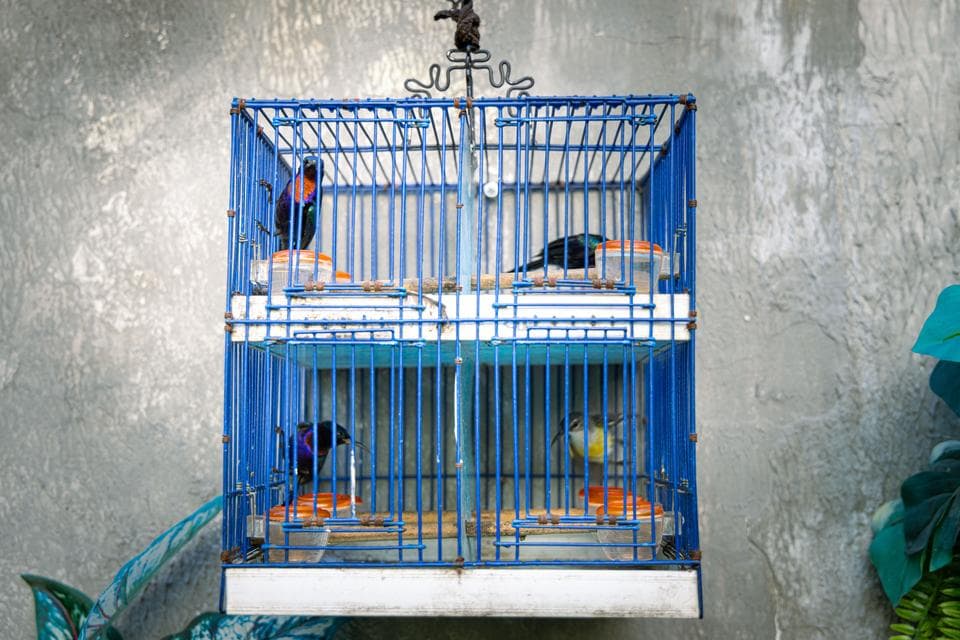
At any hour of the day or night, Phnom Penh residents can walk into a café and see a Scarlet-Backed Flowerpecker (Dicaeum cruentatum) darting around in a panic, in a trap adorned with plastic flowers used to lure songbirds from the wild.
SLAY Coffee 24H in Phnom Penh's Boeng Keng Kang 3 neighbourhood opened an all-hours outpost across from a major university campus, likely appealing to the late-night studying needs.
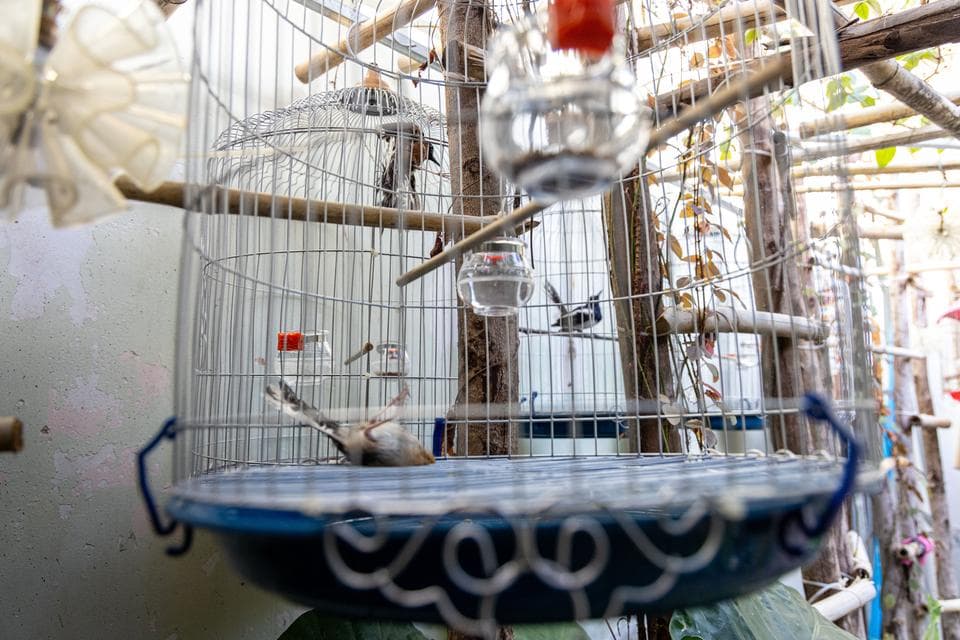
The owners chose to decorate the shop with dozens of cages housing more than 50 popular and rare songbird species, many native to Cambodia, but kept in small cages often with more than one bird per cage.
The White-Rumped Shama (Copsychus malabaricus), whose melodic serenade is usually heard drifting in early morning through lowland forests of Mondulkiri or in the royal palace grounds of Phnom Penh, lies dead at the bottom of a rusting cage. In other cages, there are White Eyes (Zosterops sp.), various Sunbirds as well as Red-Whiskered Bulbuls (Pycnonotus jocosus), a species with regionally declining populations due to hunting and trapping for the songbird trade. Amongst the avian madness, a single, listless but alive Black Giant Squirrel (Ratufa bicolor), regularly seen across Cambodian forests, is collapsed on the bottom of a cage.
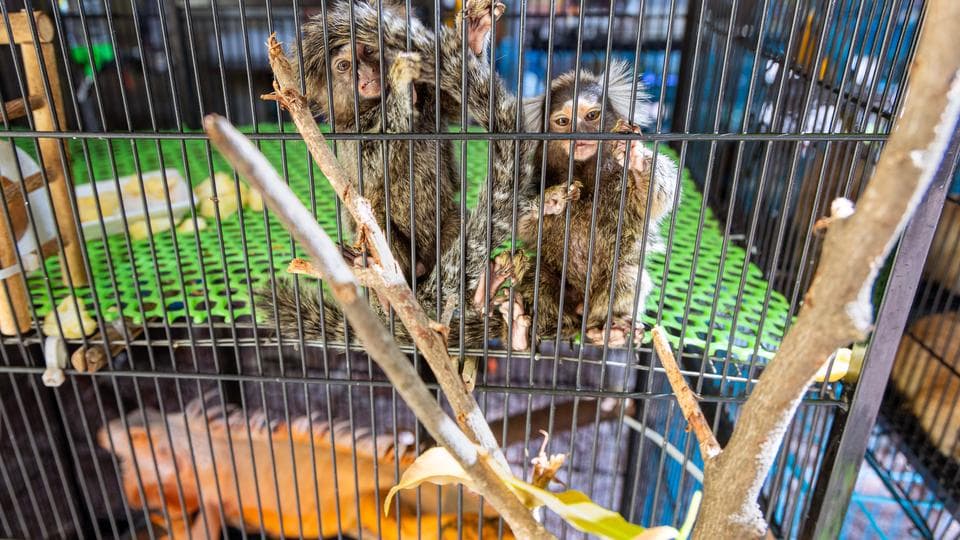
Online and off, Phnom Penh has become a hub for exotic pets, with conservationists saying they are struggling to keep up with reports from concerned civilians or calls to rehome wild animals. The seeming rise of wild animals in cafés, influencer videos, and homes indicates growth in both the regional exotic pet trade and a wild-caught economy preying on Cambodia's protected areas.
The international illegal wildlife trade is worth up to $23 billion per year, according to a 2016 report from the U.N. Environment Programme and Interpol. The trade, exacerbated by local poaching, corruption, poverty, and inadequate enforcement, shows little sign of slowing down. Cambodia in recent years has become known as a transit hub both for live wildlife and its parts, with a noticeable increase in the online trade of exotic pets locally.
A Kiripost investigation found 167 individual animals native to Cambodia sold in July, in an analysis of three exotic pet sales groups on Facebook and spot checks of five physical pet shops throughout the entire month. This analysis focuses on publicly accessible trade groups and open shops, meaning the actual volume of domestic wildlife trade is likely much greater.
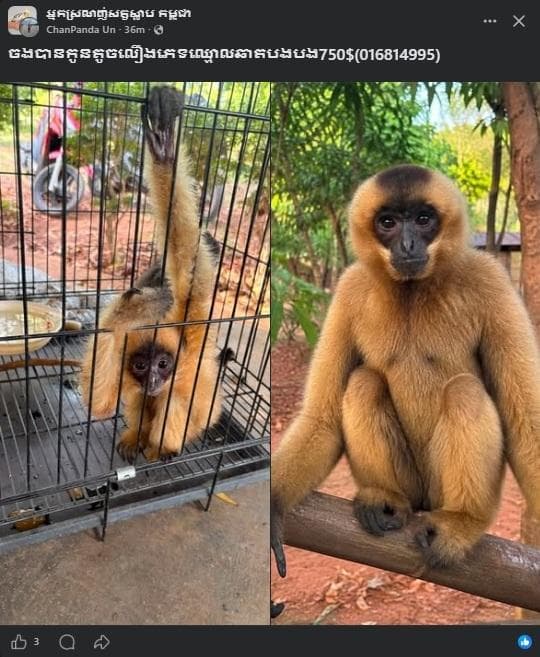
Across the three online groups, 62 separate Facebook accounts were documented selling live animals within 31 days, and 65 unique species that are native to Cambodia or Southeast Asia were found for sale. One such species, the Black-Shanked Douc (Pygathrix nigripes), exists globally only in a Cambodian stronghold area in Mondulkiri and scattered across south Vietnam. Although posts are often listed without price, requiring customers to contact the seller directly, similar species such as Gibbons have been seen advertised for more than $700.
Kiripost contacted Meta for a response, and the original story will be updated if the company replies.
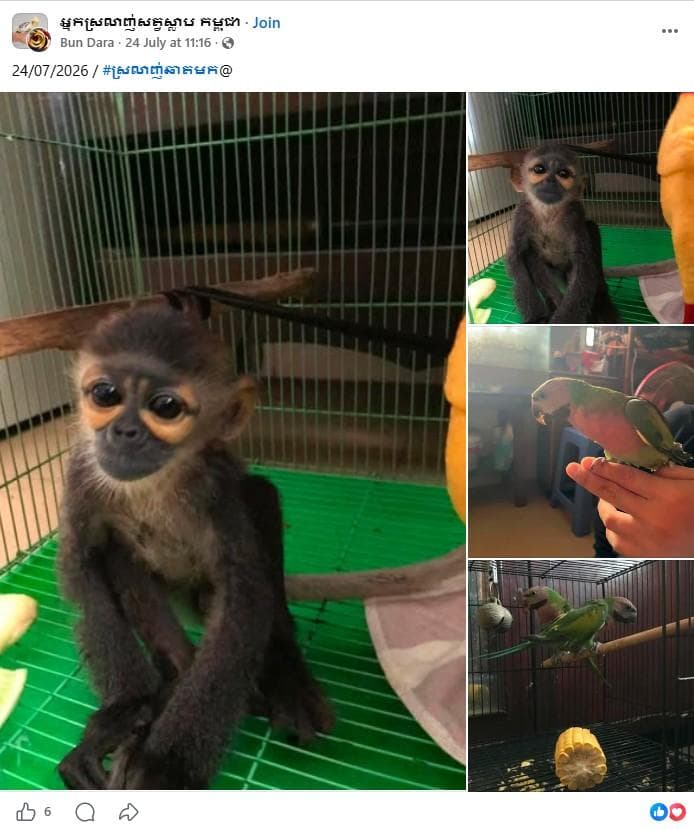
Nick Marx, co-founder of the conservation organisation Cambodia Wildlife Care (CWC), said although wildlife trade has long been an issue, he believes there has been a rise in online trading.
"Over the last six months, there seems to be a huge increase in the number of animals now being sold as pets," he said.
CWC received rescue calls for only eight mammals in January before a recent spike of 25 calls in May and 22 in June. The majority of these rescue calls are for Asian Palm Civets (Paradoxurus hermaphroditus) and Long-Tailed Macaques (Macaca fascicularis), both native to Cambodia, yet often sold into the pet trade.
While reporting was ongoing, Try Sitheng, the CEO and co-founder of CWC with Marx, publicly announced his resignation from the organisation on 8 September.
Sitheng gave a short response when asked by Kiripost for comment on his resignation, saying that he witnesses obvious wildlife trading online but cannot do anything to stop it.
"We see their faces and phone numbers, but we cannot crack down on it. It's a weak point that we are unable to address," Sitheng said, adding that he sees Chinese wildlife traders as a significant factor in the trade of endangered species.
Sitheng told Kiripost that his resignation is partly due to the lack of financial support for wildlife rescues, without specifying further.
Amid this rise in online trade, there has been an increase in Cambodian influencers producing videos using wild animals acting outside their natural state to go viral.
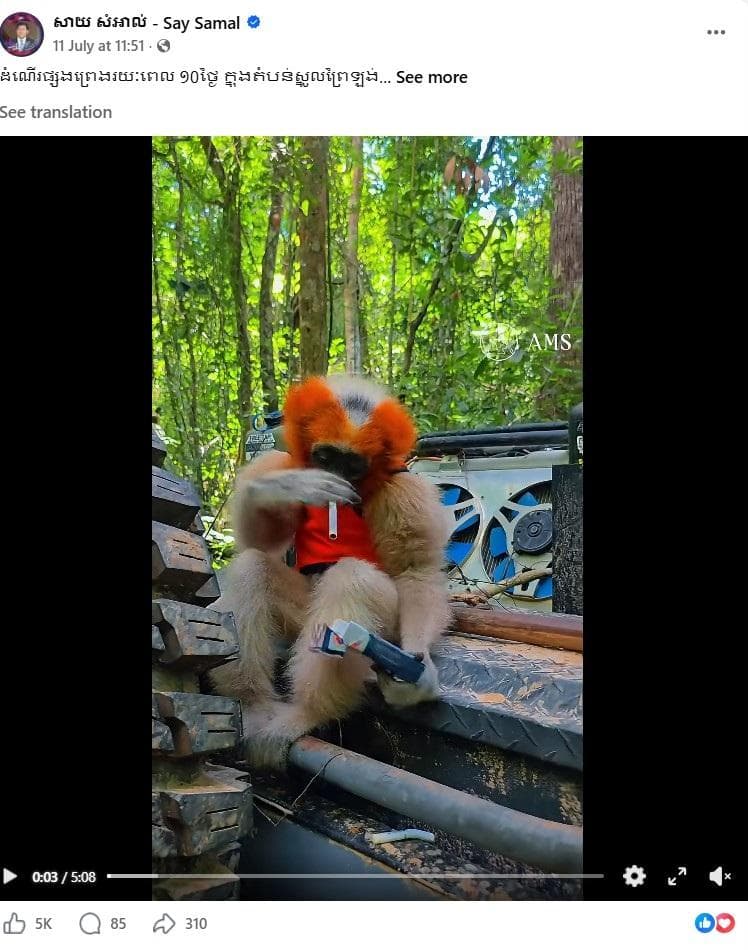
One video shared on Facebook by an outdoor influencer group called DanCherng Adventure features an endangered Pileated Gibbon (Hylobates pileatus), designated as "rare" within Cambodian law, with its hair dyed orange, playing with a packet of cigarettes and placing one in its mouth as if about to smoke.
The video, which shows influencers driving trucks into trees, streams, and brush within Prey Lang Wildlife Sanctuary, was shared by the Minister of Land Management, Urban Planning and Construction Say Sam Al for an influencer programme run by the ministry. The minister did not respond to a request for comment.
Wildlife law
Cambodia has several laws that could be used to stifle wildlife trade as it appears online and in pet shops, but they are applied by multiple ministries, making them challenging to enforce.
The Environmental and Natural Resources Code, passed in 2023, explicitly bans all types of hunting for species designated as "near threatened" through "extinct in the wild". This would include species like the Black Giant Squirrel, both Pileated and Yellow-Cheeked Gibbons, Slow Loris, and wild cat species documented during this Kiripost investigation.
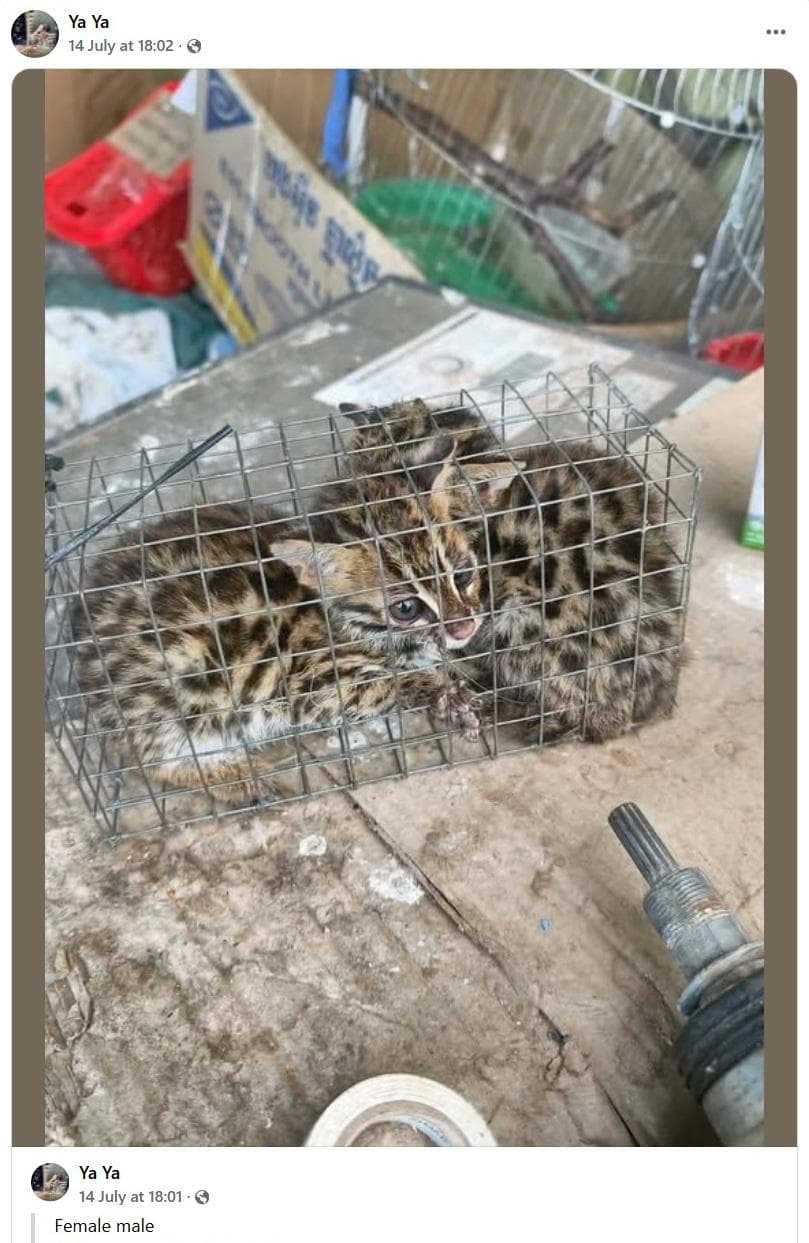
Other codes include Articles 48 and 49 of the 2002 Law on Forestry, which prohibit trafficking of all wildlife native to Cambodia, including eggs, offspring, and other components, with the exception of fish and animals that breed in water. They establish a three-tier system prohibiting the harassment, harm, trapping, and possession of wildlife species classified within Cambodia as rare or endangered under the government document Prakas No.20, an amendment that specifies 92 species native to and protected in Cambodia.
In response to questions from Kiripost, Khvay Atitya, spokesman for the Ministry of Environment (MoE), released a statement strictly condemning wildlife trafficking and online sales of wildlife.
The ministry acknowledged that there are no explicit laws that comprehensively ban wildlife trafficking, but there are some rules that could be applied to penalise wildlife traffickers.
"It should be noted that although there is no single, specific law governing the online trade of wildlife, any activity involving the advertising, sale, ordering, or transport of wildlife, specimens, or eggs via social media platforms is considered a 'flagrant offense'," Atitya said in the statement.
The ministry said that infringement of any applicable wildlife laws in the current environmental code is punishable by a maximum jail term of 10 years and includes additional penalties.
Atitya wrote in a response: "Pursuant to the Environment and Natural Resources Code, specifically, Articles 380(11) and 141, wildlife trafficking is prohibited; penalties are prescribed under Article 851, Point (a), classifying this as a Tier 3 natural resource offense."
Article 380(11) of the code does not appear to exist, while Article 380 appears to refer to the presence of armed forces in protected areas. Article 141 then refers to access to information on energy, so it was not immediately clear which laws he was referring to. However, Article 851 prescribes a punishment of between five and 10 years in prison for several crimes, including importing or exporting wild animals in protected areas or various types of hunting without permission.
The ministry urged people to "stop producing or disseminating content that promotes, encourages, or depicts the trafficking, consumption, and capture of wildlife, activities that are illegal and detrimental to both health and the environment."
The Ministry of Agriculture, Forestry and Fisheries said in response to questions from Kiripost that it "remain[s] committed to upholding and enforcing all applicable wildlife and trade laws."
John Willis, chief executive officer of the conservation organisation Wildlife Alliance, said the Cambodian government and his NGO used to operate a joint enforcement body to confiscate and rehabilitate native and non-native species, called the Wildlife Rapid Rescue Team (WRRT).
Willis said that the conservation organisation "concluded its support and fully transitioned the [WRRT] programme to Ministry of Agriculture, Forestry and Fisheries (MAFF)" in 2025 after redirecting its programmes toward "forest protection through the Southern Cardamom and Samkos REDD+ Projects."
Marx, the co-founder of CWC, said he regretted the end of the programme, which he previously worked with under Wildlife Alliance. He said the programme, which used both MAFF officials and Cambodian Military Police to enforce wildlife law, was effective at fighting wildlife trade.
"I think it was the envy of the world here in Asia," Marx told Kiripost. "It did such a good job cleaning up the wildlife trade."
When asked about the current situation of the WRRT, MAFF responded that under its new leadership, it remains dedicated to countering wildlife crime specifically in the Cardamom Mountains region, without providing further details.
The power of digital presence
In this landscape of unclear enforcement, wildlife trade has thrived online, driven by a rise in influencers using exotic animals to gain likes and shares.
One wildlife trade investigator who prefers to remain anonymous commented on the impact of social media in the region, saying "exotic animal trends start in Thailand or Vietnam and filter into Cambodia." Meta, the parent company of Facebook, was recently investigated in a report, "Clicks that Kill," by the global counter-trafficking NGO Freeland. The report noted that Facebook had poor content monitoring of posts that sell, trade, and promote wild animals, with the platform's own algorithms rewarding, monetising, and thereby encouraging accounts that exploit wildlife.
In Cambodia, there have been a slew of influencers selling animals or exploiting them as clickbait to sell beauty products and more.
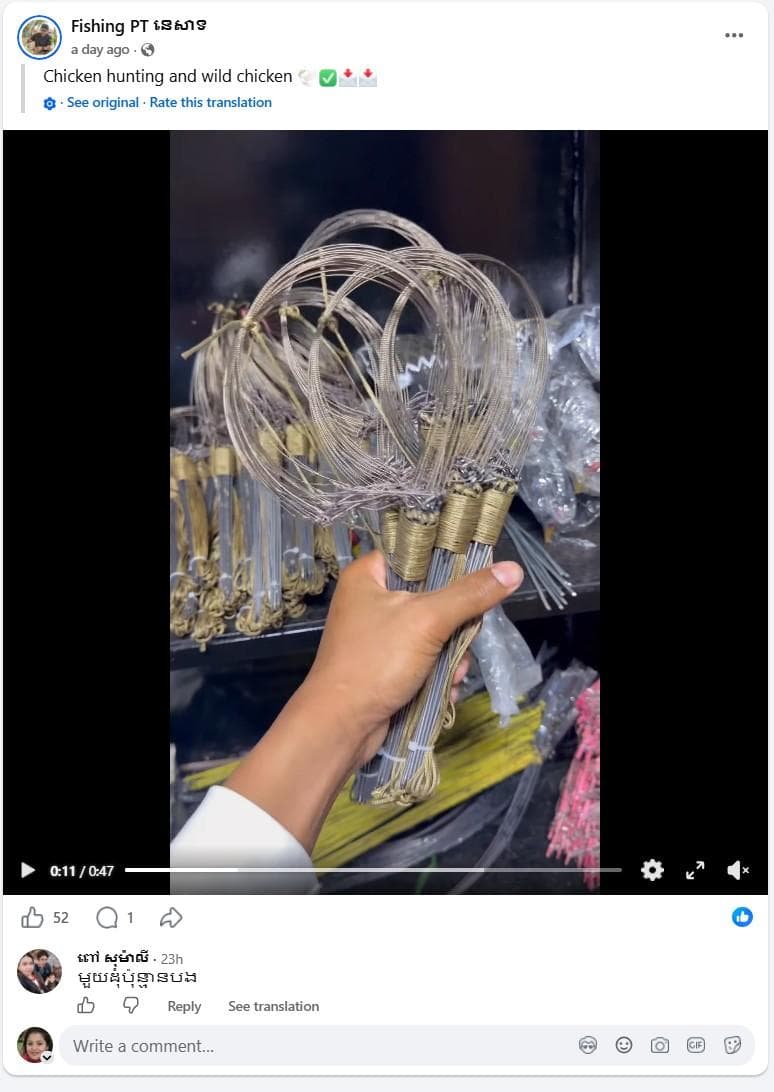
Several Khmer-language accounts almost exclusively educate people about trapping animals in the wild and provide links and advice on purchasing relevant traps, snares, and equipment. Fishing PT នេសាទ, an account with 184,000 followers, for example, displayed a video showing three Javan Mongoose (Herpestes javanicus) caught in one of its traps.
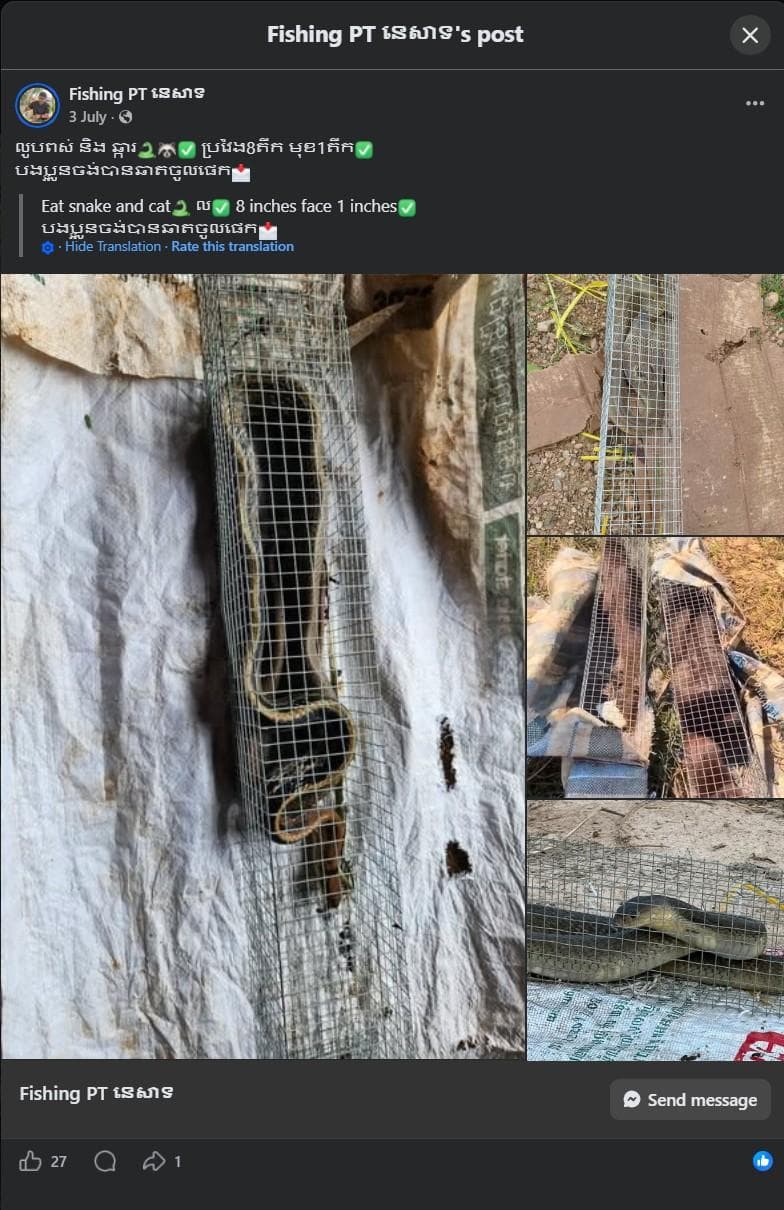
Other influencers, like Lisa Srey, use wild animals to advertise cosmetics. In one video, she put a wig on a crocodile to test hair products. Private ownership of crocodiles is illegal without a licence under the 2006 Law on Fisheries. Though the crocodile does not know the law, it protested Lisa Srey's actions by biting her in a video that went viral in June.
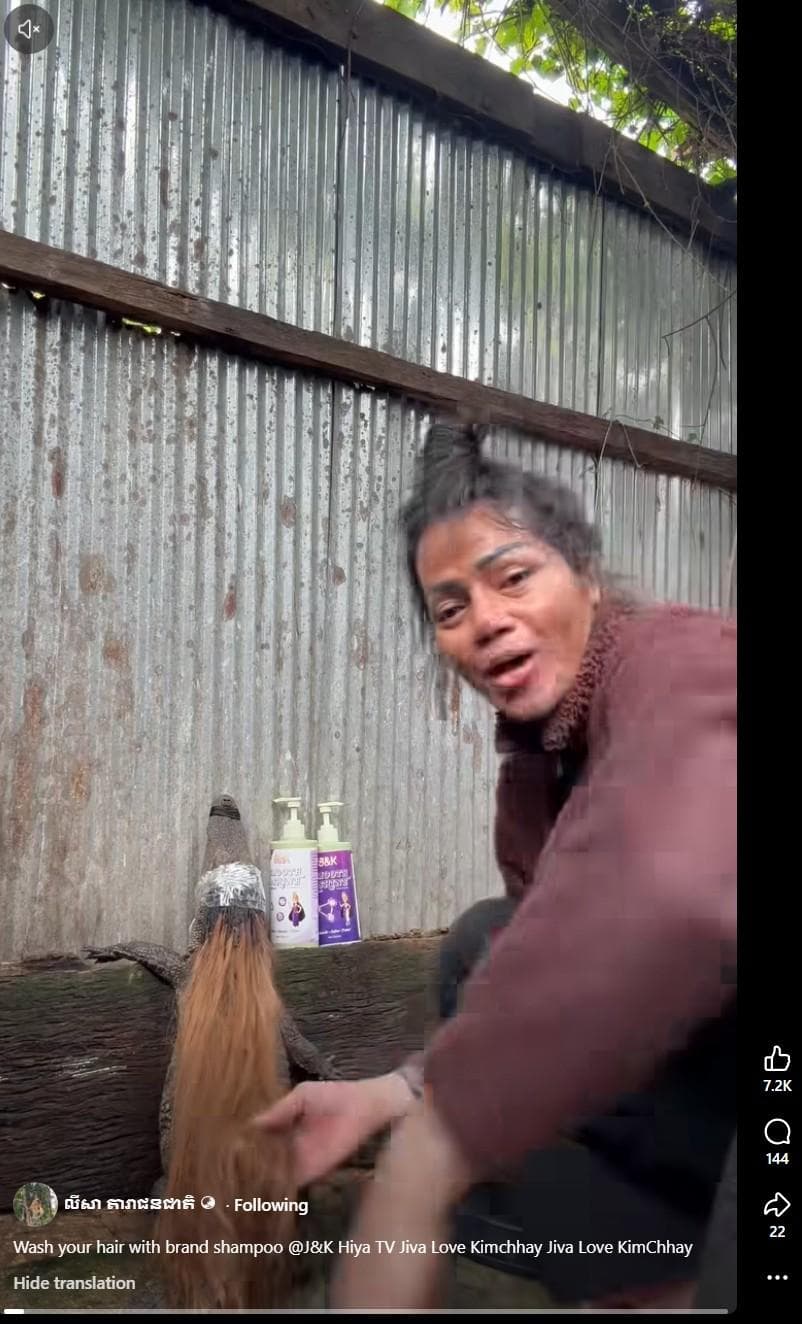
Kiripost sent an email to Meta, the parent company of Facebook, to ask about the sales and use of wildlife on its platform. The original story will be updated if the company responds. Neither Fishing PT នេសាទ nor Lisa Srey responded to requests for comment.
Neary Chalat Chor, an outdoors influencer with 295,000 followers, recently went viral for her commentary against the wild pet trade, receiving 24,000 likes and nearly 10,000 shares for speaking out against the availability of animals on the internet.
She believed this was in part because people online are tired of witnessing animal abuse and exploitation.
"I started to see people selling animals on social media, and I was surprised," she told Kiripost. "I think before, people were scared of the law. They didn't do it publicly. So, I think this is my time to produce content for caring about them [animals], showing people about how important biodiversity and wild animals are."
Some aspects of the trade investigation indicated that buyers harboured misconceptions about the ethics of wildlife trade.
Disregarding laws of possession, many of the Cambodian-native species that are sold online, including gibbons, lorises, and langurs, are notoriously difficult to breed in captivity.
Studies show that traders will claim wildlife are farm-raised, but the trade can actually involve a form of wildlife laundering, in which wild animals are sold through "reputable" farms to disguise their illegal entry into the market.
When asked about his business by Kiripost, one online trader with the account name "ChanPanda Un" said he believed his trade was an act of conservation.
Without giving his real name, ChanPanda Un said that he buys animals from Laos, where they "have a lot of farms" of endangered animals, before transporting them to Cambodia. The account, with more than 5,300 followers, advertised the sale of dozens of animals listed internationally as critically endangered, with some specifically protected under Cambodian law on locally threatened wildlife: Pileated Gibbon, Yellow-Cheeked Gibbon (Nomascus gabriellae), Asian Small-Clawed Otter (Aonyx cinereus), tiger cubs, Elongated Tortoise (Indotestudo elongata), Silver Langur (Trachypithecus cristatus), and Pygmy Slow Loris (Xanthonycticebus pygmaeus).
"I can buy any endangered animal that is on the red list and [bring it] to Cambodia for conservation, not for eating or killing, to preserve it so that children can know it," ChanPanda said.
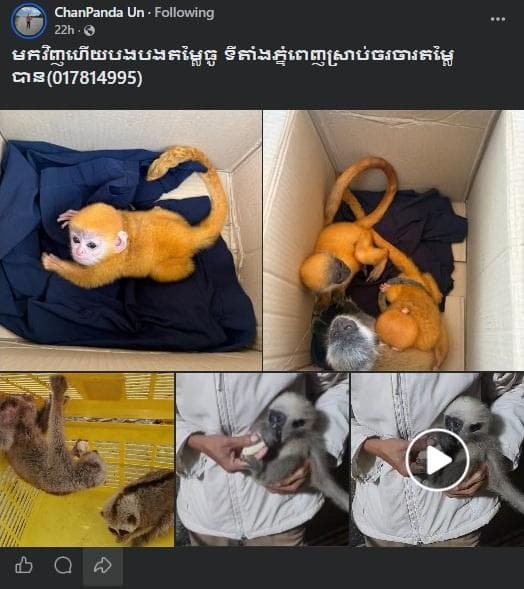
He told Kiripost he would sell a tiger for $13,000 or a bear for $2,000. He added that he believed his buyers to be people with large land areas or resorts near forests in Cambodia.
A brick-and-mortar pet shop manager in Phnom Penh echoed this mindset when asked questions by a journalist posing as a customer.
"Generally speaking, people can keep them [wildlife] as pets without breaking the law, and they don't need to apply for any permit. But for us sellers, we are not allowed to sell them," they said.
A reporter later asked for comment on the record, but they refused to comment further.
The shop sold common cats and dogs in cages, as well as some exotic species of iguanas, prairie dogs, Blue-and-Yellow and Scarlet Macaws (Ara ararauna and Ara macao), and many other smaller bird species. The animals were kept in stacked cages, and several paced in their cages or showed signs of sickness or heat stress, which also increases the risk of zoonotic disease transmission.
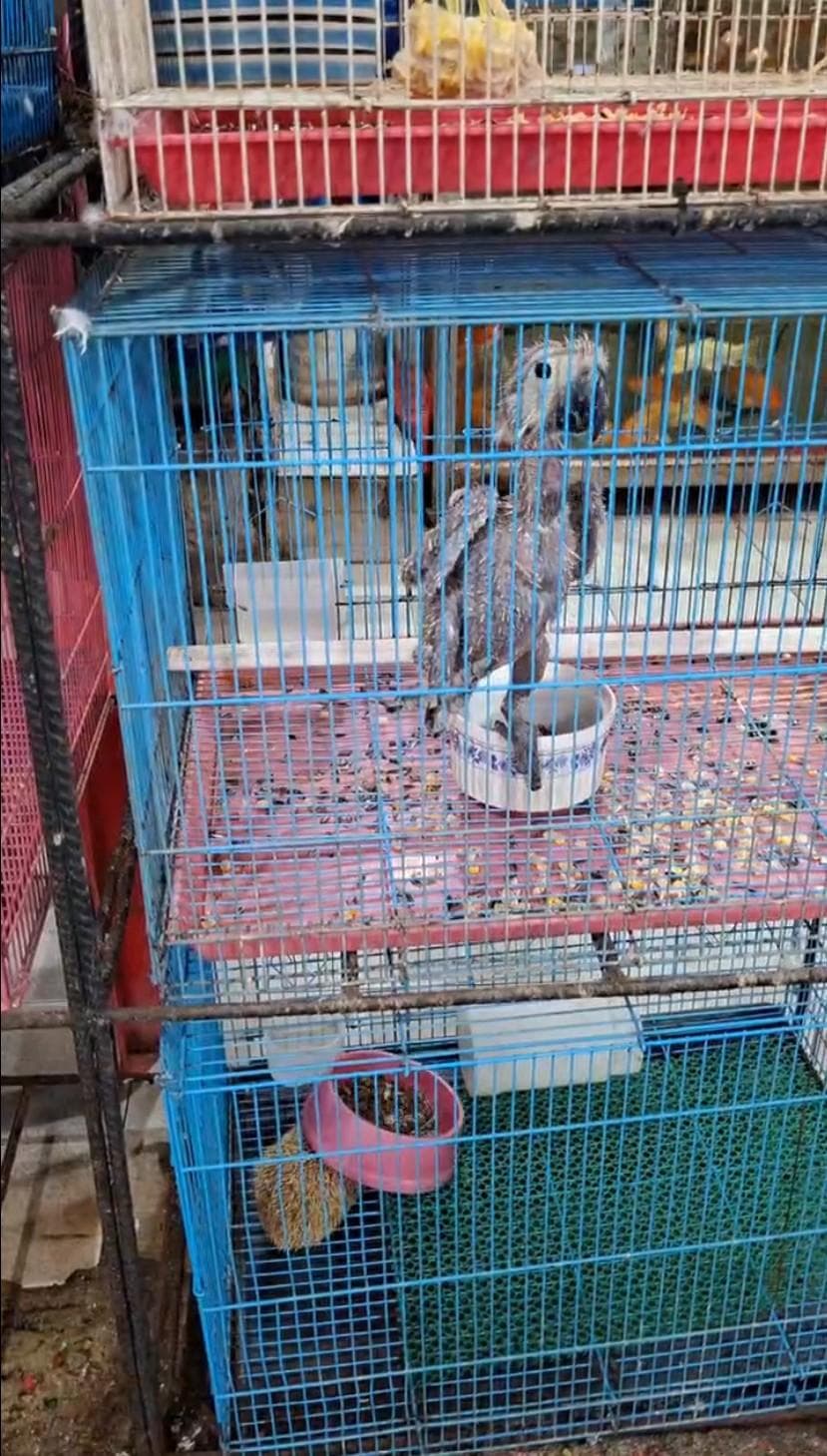
Marx, of CWC, said these are often the animals he has to rescue weekly.
"They [wild pet owners] get tired of looking after it or don't really have the facilities to look after it, or just generally get bored of the hassle. They call us to do that job for them, to take the responsibility off their hands," he said.
He added that animal husbandry professionals like himself are trained to handle animals that are not domesticated, but almost all civilians who purchase wild animals are unable to meet their needs.
"In the end, you're going to have to get rid of them," Marx said. "One way or another, you're not going to be able to keep them."
Conservationists call for boycott
Within 24 hours of Kiripost's request for comment, a local news outlet reshared the statement from spokesperson Khvay Atitya of the Ministry of Environment.
The ministry called for civilians, journalists, social media content creators, and others to stop offences against natural resources and wildlife trafficking and to raise awareness about the proper treatment of wildlife.
When reached for comment, MAFF encouraged "anyone with information regarding illegal activities in the exotic pet market to come forward and report it directly to our team so prompt action can be taken."
Though Marx said CWC was strained by the number of calls, he still encouraged residents to report when they see online trade. He also encouraged civilians to make smart choices while visiting pet shops or perusing Facebook sales.
"Wild animals make bad pets. Please do not buy them. Report the sellers to the authorities," Marx said. "If everyone stops buying wild animals, the illegal wildlife trade will cease to exist."
CWC encourages people in Cambodia to report wildlife trade via a Telegram number on its website.
Neary, the adventure travel influencer, said she hopes that other Cambodians can follow her lead and build their online profiles by appreciating nature as it is, rather than removing animals from their habitats.
"Animals have rights, like a part of the earth," Neary said. "Therefore, I would like to encourage all of us to live in peace and harmony with nature."
Though calls to stop the wildlife trade abound, shops and influencers continue to keep wildlife as part of their business model.
After requesting contact details for the shop, a reporter contacted the owner of SLAY Coffee 24H, the all-hours café with birds displayed in flower-covered traps. The owner answered some messages on Telegram, saying that the animals were brought in from Vietnam, but did not explicitly answer whether birds came from Cambodia.
Written by
Conservation Biologist & Wildlife Trade Researcher
Adam RobertsAdam Roberts is a conservation biologist, wildlife trade researcher, and wildlife photographer based in Cambodia. He holds an MSc from the Durrell Institute of Conservation and Ecology and has more than 15 years of field experience across Africa and Southeast Asia. His work examines the pressures facing wildlife and the systems that enable illicit trade, pairing field research with photography and public-interest reporting.
Read full profile →More from Untold News
Original and community reporting published through the Untold News desk.
 Greenford, London, United KingdomNew
Dam Good Idea: The London Beavers Offering Respite from Drought
In a west London wetland, beavers are slowing floods, holding water through drought and offering a grounded lesson in how nature-based solutions can help cities adapt to climate extremes.

Eleanor Jolliffe
Oct 19, 20265 min
Explore Untold Stories
Firsthand essays, field notes, and visual stories from the wider Untold community.
- Wildlife
 Holbox Island, Mexico
Holbox Wildlife: How Urbanization Is Reshaping Mexico's Yucatán Peninsula
On a sandbar island where flamingos still wade the shallows, rapid development is rewriting the rules of coexistence between people and the wild.

Tamara Blazquez Haik
Feb 17, 20266 min
- Wildlife
 Svalbard, Norway
Climate Change and the Arctic Fox: The Red Fox Invasion
As the Arctic warms, the red fox is pushing north into territory the arctic fox has held for millennia — a quiet contest with the climate as referee.

Jacob Buck
Aug 15, 20244 min
- Wildlife
 Etosha & the Namib, Namibia
The Enchantment of African Wildlife: A Photographer's Heaven
From dawn light on the savanna to the hush before a sighting, a photographer's love letter to the continent that first taught them to look.

Amber
Nov 6, 20245 min
- Wildlife
 Bwindi Impenetrable Forest, Uganda
Mountain Gorilla Trekking in Bwindi Impenetrable Forest: An Adventure of a Lifetime
Deep in Uganda's impenetrable forest, ecotourism has become an unlikely lifeline for one of the planet's rarest apes.

Jenna Price Mercurio
Aug 1, 20255 min
- Wildlife
 Central Florida, United States
Photographing Wildlife in Your Own Yard
You do not need a passport to find the wild. The most patient nature photography often begins just outside the back door.

Karen González Videla
Jun 26, 20255 min
- People
 Serengeti National Park, TanzaniaNew
Holding the Door Open
From Ireland to Tanzania, from Hugo van Lawick's Serengeti camp to Queens and the ASC, Sophie Darlington reflects on access, mentorship, representation, and the responsibility to bring others in.

Sophie Darlington
Jul 23, 20265 min
- Birds
 Agartala, IndiaNew
The Rarest Bird in Agartala: a Global Story of Birds Disappearing in Plain Sight
In a north-eastern Indian town where old trees fall and ponds are filled overnight, the scarcest species isn't a bird at all. It's the birdwatcher, and noticing may be the simplest conservation there is.

Dhrubajyoti Bhattacharjee
Jun 30, 20267 min
- Conservation
 Maasai Mara, Kenya
Learning to See Connection: What Long-Term Photography Reveals About Conservation
Returning to the same landscapes year after year, a photographer learns that the real story is rarely the dramatic moment — it is the slow relationship between land, wildlife, and the people who tend it.

Georgina Goodwin
Apr 15, 20264 min